
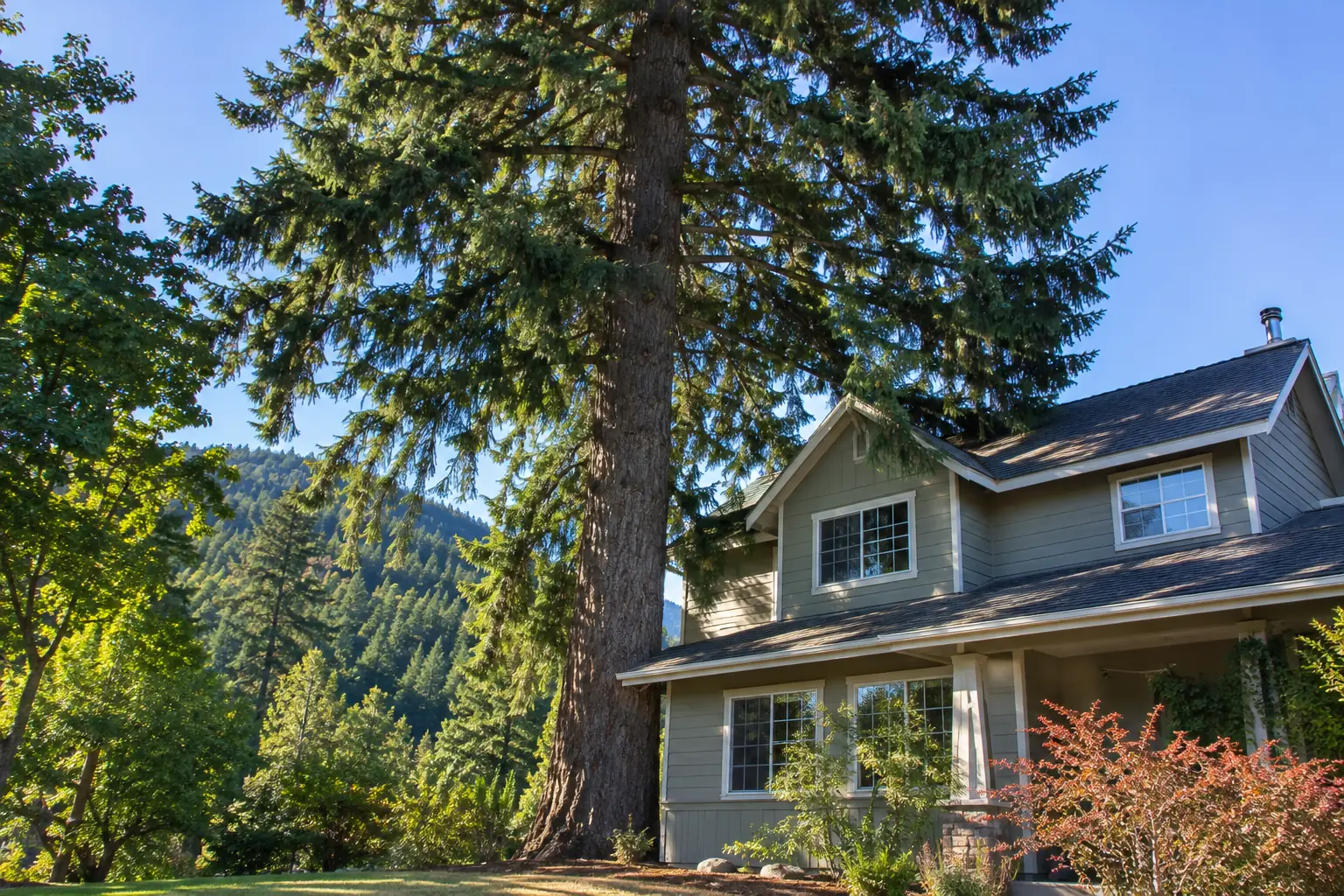
A tall pine or fir close to a house in Medford usually comes down in sections, cut from the top and lowered on ropes or lifted out by crane, so nothing lands on the roof. Call (541) 200-0074 to reach a tree service, namely the one local CCB-licensed company this number rings, about large tree removal and a price based on your yard.
Tree Removal Medford is a free referral service, not a tree company. The company you are connected with plans and does the work. This page explains why big trees near homes take more planning, the main ways crews take them down, what the company needs to know about your property, and what moves the price up or down. Go to the home page for an overview.
Why tall trees near homes need a planned removal
A large tree close to a house cannot simply be felled, because there is no open ground for it to land on. The company has to bring it down a piece at a time, and every piece has to go somewhere safe.
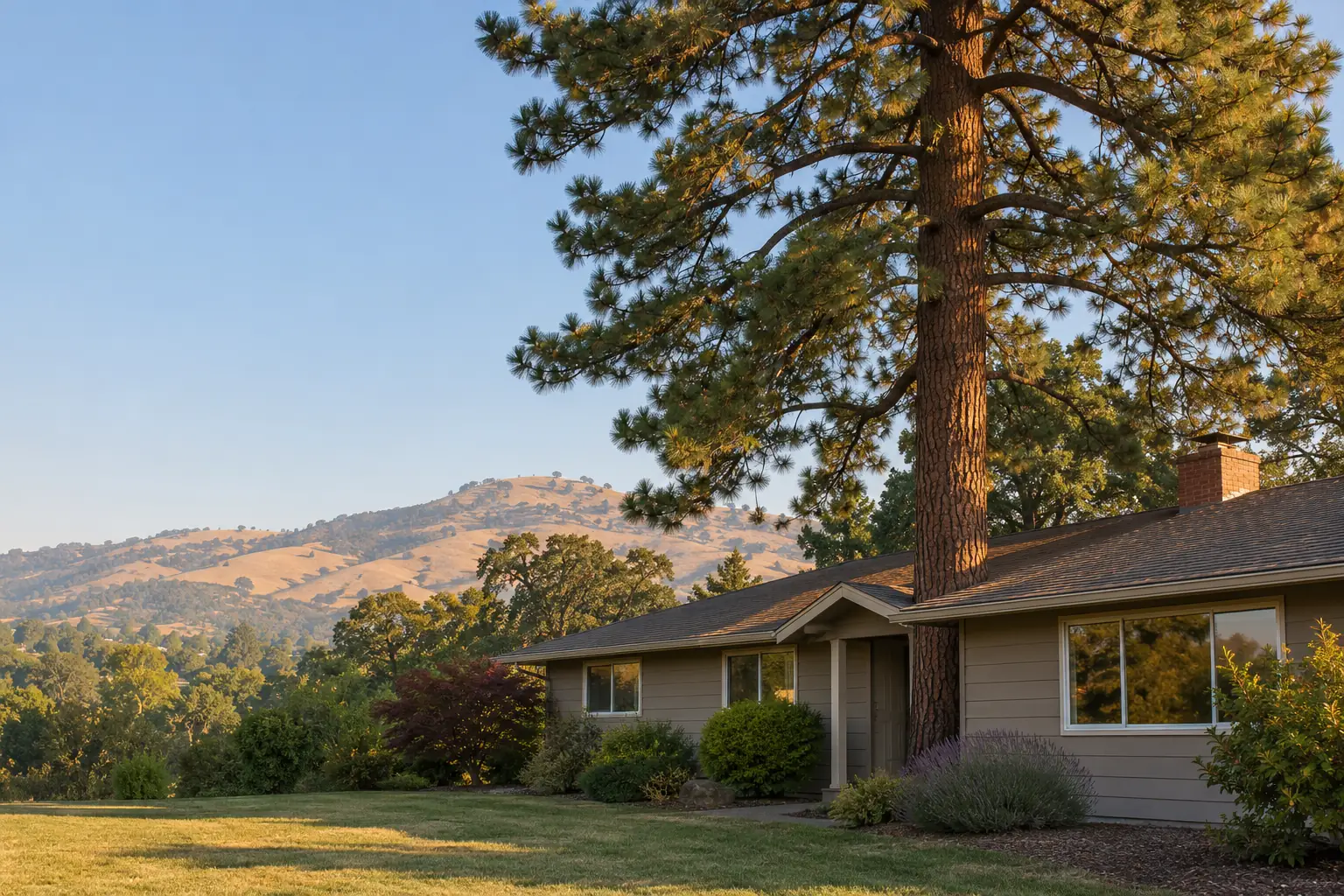
Douglas-fir and ponderosa pine are two large conifers that grow across the Rogue Valley. OSU Extension has documented widespread Douglas-fir decline in Jackson, Josephine and Douglas counties (OSU Extension, Trees on the edge, September 2023), and the Oregon Department of Forestry notes that ponderosa pine in the oak zone of southwestern Oregon is open to western pine beetle attack in dry years (ODF western pine beetle fact sheet). A dead or dying tree of either kind next to a house is one of the most common reasons people look into large tree removal. If yours is showing warning signs, the page on hazard and dead tree removal goes through them.
Other reasons homeowners remove a big healthy tree include roots lifting a driveway or foundation area, limbs over the roof, needles clogging gutters, and space for an addition. Before you remove a healthy tree, check the rules. The guide on tree removal permits in Medford explains the general questions, and the City of Medford or Jackson County can confirm what applies to your lot.
How crews take a large tree down in sections
Most large removals near homes use one of a few methods, or a mix of them. The company picks the method after it sees the tree, the house and the yard.
Climbing and rigging
In a rigging job, a climber goes up the tree on ropes and removes it from the top down. Limbs come off first. Then the trunk is cut into sections, often a few feet at a time.
Pieces that cannot be dropped are tied off before the cut and lowered to the ground on a rope. The rope usually runs through a pulley or block set higher in the tree and down to a friction device at the base, so a ground worker controls how fast each piece comes down. This lets the crew steer heavy wood away from the roof, fence and garden.
Rigging takes time, and it takes skill. It is also the method that works in tight backyards where no machine can reach.
Bucket trucks
A bucket truck puts a worker in a lift beside the tree instead of in it. It is useful when the tree is near the street or driveway and the truck can park close. It cannot help much in a fenced backyard the truck cannot reach.
Cranes
On some jobs, a crane lifts whole sections of the tree over the house and sets them down in the street or driveway. The climber attaches the crane's line to a section, cuts it free, and the crane carries it away. This can be faster and gentler on the yard than lowering many small pieces, especially for a very large tree leaning over a roof.
A crane needs a firm, level place to set up near the tree, room to extend its supports, and a clear path to swing the load. Overhead wires can rule it out or limit it. The company will tell you if a crane makes sense and how it would change the price.
Felling in one piece
If there is open ground in the direction the tree can fall, the company may take part of the tree down in sections and fell the rest in one piece. This is quicker but needs a clear landing zone longer than the remaining trunk.
Every method carries real risk for the people doing it. The federal safety agency lists falls, falling objects and electricity among the main hazards of tree care work (OSHA tree care industry). This is one reason large tree removal near a house is a job to hand to a licensed company rather than to try yourself.
Access around your property
How the crew gets to the tree, and where the wood goes, shapes the whole job. Walk the route from the street to the tree before the estimate visit, and point out anything that could be damaged or get in the way.
Fences and gates
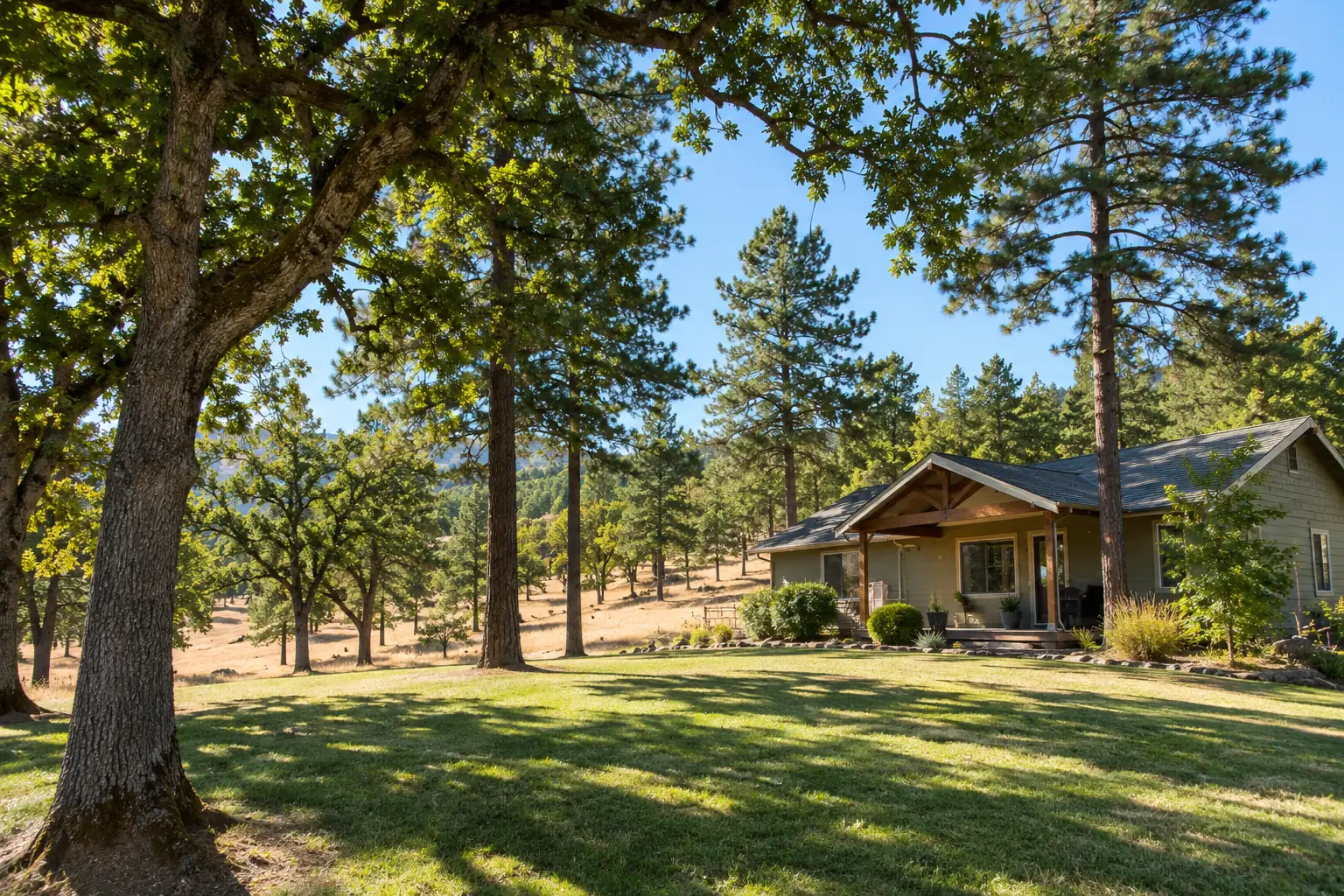
A narrow side gate can mean everything has to be carried out by hand. Measure the gate opening and tell the company. Sometimes a fence panel can be taken down and put back, and the company can tell you whether that would save time. Ask how it plans to protect a fence that runs under the tree.
Driveways and lawns
Heavy equipment and trucks can crack an older driveway or leave ruts in a wet lawn. Ask where the trucks will park, whether the company uses mats or plywood to spread the weight, and who is responsible if a sprinkler head or edging gets damaged.
Septic systems
If your home has a septic system, show the company where the tank and drainfield are. Septic guidance from Washington County, Oregon, says not to drive over the septic tank or drainfield (Washington County septic do's and don'ts). That rules out some truck and crane positions, and it may mean wood has to be moved a longer way.
Underground lines
Sprinkler pipes, low-voltage lighting, and private power lines to a shop or well pump are not always marked by the utility. Oregon's locate service says utilities mark their lines to the meter or the connection point of your private service (Oregon Utility Notification Center FAQ). Anything past that point is yours to know about. Tell the company what you know, especially if the stump will be ground. The page on stump grinding in Medford explains the 811 call.
Neighbors
If the tree hangs over a neighbor's yard, or the crew needs to set up there, talk to the neighbor before the work date. Questions about whose tree it is, or who pays, are best settled with the neighbor and, if needed, your insurer.
Power lines near a large tree
If a large tree grows near the wires that run from the pole to your house, the utility may need to be part of the plan. Pacific Power offers a free temporary service disconnect so tree work near your service line can be done safely, and it takes tree questions at 1-888-221-7070 (Pacific Power tree pruning and planting). Pacific Power also warns never to prune limbs or remove trees near power lines yourself.
Ask the tree company whether your tree is close enough to the lines to need that call, and who will make it. For more detail, read trees near power lines in Medford.
What affects the price of large tree removal
The price of a large tree removal depends on the tree and on your yard. Two trees of the same height can be priced very differently. The main factors are:
- Height and trunk size. More wood means more cuts, more lowering and more hauling.
- What is under it. A tree over a roof or wires needs slower rigging than one over open lawn.
- Method. A crane adds the cost of the crane but can shorten the job. Rigging adds time.
- Access. A backyard tree behind a narrow gate takes more labor than one beside the driveway.
- Condition. A dead or decayed tree can be harder to climb and rig.
- Cleanup. Hauling away all the wood costs more than leaving rounds cut for firewood.
- The stump. Grinding may be a separate line on the estimate.
The number that counts is the estimate the company writes after it has stood in your yard. Coming out to quote an everyday job seldom carries a fee, but settle that when you call. For ranges and the other questions that come up, read the tree removal cost guide for Medford.
Questions to ask before you say yes
A short list of questions makes estimates easier to compare. Ask each company:
- What is your CCB number? You can check any contractor's license at the Oregon CCB license search.
- How will you take the tree down: rigging, bucket truck, crane, or a mix?
- Where will trucks park, and how will you protect the driveway, lawn and fence?
- Is cleanup included, and what happens to the wood and chips?
- Is the stump included?
- Do you need anything from me, such as a gate opened, cars moved, or a call to Pacific Power?
- Is the price in writing?
Large tree removal in towns near Medford
Tall pines, firs and oaks grow close to homes across the valley, and the same number works outside Medford. Homeowners in Central Point, Jacksonville, Phoenix, Eagle Point and White City are put through to the same independent company and can ask whether it brings large-tree equipment out their way. On sloped or wooded lots, mention the slope and the distance from the road to the tree when you call, since both affect which method the company can use. If a large tree has already cracked or fallen in a storm, go to emergency tree removal in Medford.
Frequently asked questions
How do you remove a tall tree that is right next to the house?
It is usually taken down in sections from the top. A climber removes limbs, then cuts the trunk into pieces that are lowered on ropes or lifted out by crane. The company decides on the method after it sees the tree and the yard.
When is a crane used for tree removal?
A crane is used when sections are too heavy or too awkward to lower by rope, or when there is nowhere safe to lower them. It needs a firm, level place to set up and a clear path over the house. Overhead wires can limit its use.
Will the equipment damage my lawn or driveway?
Heavy trucks can leave ruts or crack older pavement. Ask the company where it will park, whether it uses mats or plywood, and how it handles damage. Show it where your septic tank and drainfield are so it can keep vehicles off them.
Do I need to call Pacific Power before a big tree is removed?
If the tree is near the lines that run to your house, the utility may need to disconnect service while the work is done. Pacific Power offers a free temporary service disconnect. Ask the tree company whether your job needs one.
Why do estimates for the same tree vary so much?
Companies may plan different methods, include different amounts of cleanup, or price the stump separately. Ask each one how it will take the tree down and what the price includes, then compare the written estimates line by line.